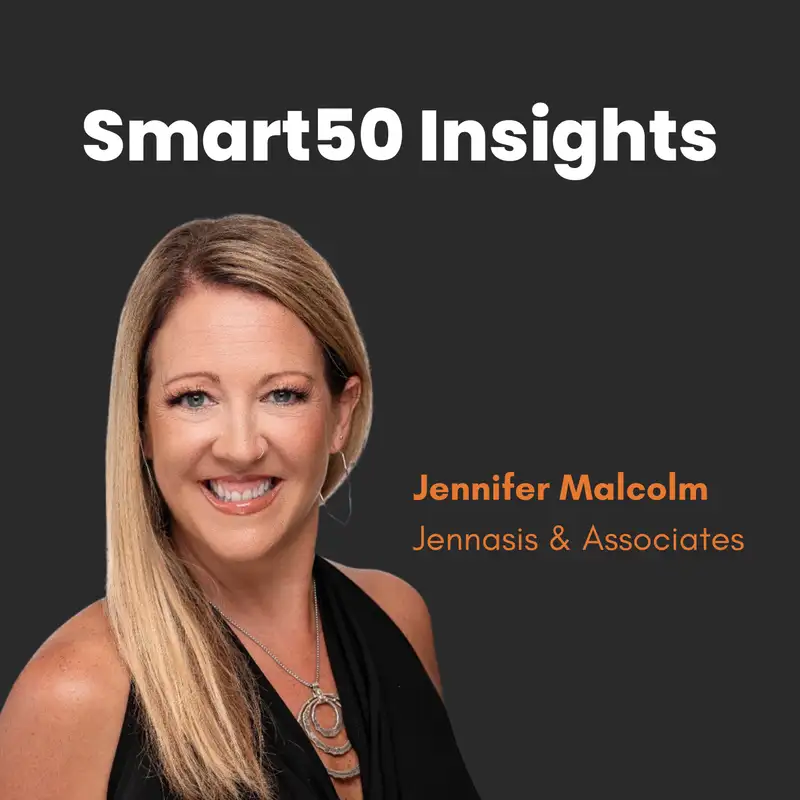
10-6-25 Jennifer Malcolm • Jennasis & Associates
Sometimes entrepreneurship comes from a grand vision or sometimes unavoidable necessity.
As part of our continuing series looking at the Smart 50 honorees for 2025, I had a great
conversation with Jennifer Malcolm of Jennasis Associates where she actually had a little
bit of both.
She, uh necessity created an opportunity to develop a great vision.
uh And because she focused on people,
And she created great success for herself and for her company.
So please enjoy my conversation with Jennifer Malcom
Welcome to Layer the Land weekly impact.
This is Jim Haviland and we are doing our 2025 Smart 50 edition where I'm interviewing all
of the Smart 50 honorees.
And I'm here with Jennifer Malcolm.
Jennifer, how are you doing today?
I'm doing well.
Thank you, Jim.
So I'm not meeting you today.
We've had plenty of conversation, but I'm not surprised to see you here.
it's fun to see you.
It's fun.
Jim, you and I.
I've had some really beautiful conversations over the last year and it's just fun to be
here with you today.
appreciate that so much.
Well, so let's give everyone a bit of your story.
So tell me where you kind of came from and how you created the business that we're in
today.
Sure.
So I started Jennasis in 2011 as a product of divorce.
I was a single mom and it was the question of who do you want to be when you grow up?
What do want your life to look like?
At that point, I had a four, six and seven-year-old kids.
Wow.
And I wanted to be able to give them balance and still have mom around without um trying
to lessen the blow of divorce.
And at that time, I had previously done, I was a high school science teacher out of
college, but I had learned the art of virtual admin work.
so Genesis started in 2011 as a virtual admin firm in Cleveland, which was unheard of.
It's now very first language.
It was known in New York down to DC.
It was known on the California coast, but Midwest did not know what a VA was.
It takes a minute for us to catch up.
It propagated across.
It started there just to have supplemental money to raise my babies and to have work-life
balance.
I could do it from home.
Then uh within a few months, it was, do you do websites?
Do you do graphics?
I was like,
Yes, we do.
And I remember the first trifold I did to a partner and they were like, this is it.
And I was like, yeah, like any other concept.
And I was like, no, cause I'm not a graphic designer.
And so I learned the art of outsourcing and partnering and using other graphic designers
and web designers to start marketing.
And so it just morphed from marketing support to now we are your tactical marketing team,
your outsource team.
which then turned into, don't agree with your list because there's better strategies.
And so we became a strategic partner and started fractional CMO work for organizations.
And so down the rabbit hole we go.
Well, that is like one of the hard parts, Is you're going to be judged by the outcomes
that you produce.
And so if you don't have enough control, then you can't really promise outcomes.
And so people are going to...
oh They're to fire you if you don't have outcomes, right?
I'm guessing that's how it went down.
But at the same time, you don't want to be everything to everybody.
So how do you niche down?
How do you focus on something that you can really do well?
And that's what we've battled is are we the agency that can do everything for everyone or
how do we morph in and just really niche down?
And so we've done our business plan over and over and over again.
Part of today is realizing, you Google marketing agency Northeast Ohio, there's probably
1200 agencies that will pop up, solopreneurs and organizations.
so what we do is we continue to innovate and try to be ahead of the curve.
uh AI, Canva, tools like that continue to squish into the marketing.
And so what we've done is continue to evolve and become strategic voices within
organizations.
We still have that backflow of office that can handle your social media, build your
website, run your campaigns, all of that.
But we also have now a tenured group of leaders who are now strategic voices within an
organization that can say, want to get from here to there, here to there over the next 10
years, how do you do it?
And so we are able now to be nimble and create what we call vision days for organizations
to lay out that plan.
And then my husband is a uh EOS integrator.
And so he can come in and run the process and the teams if needed.
I come in from the visionary and here's a big picture and opportunity.
And it's a real well-oiled machine.
um The yin and the yang coming together, black and the white.
The VI pair, we like to say.
pair.
Well, within the EOS world, we often talk about the importance of having everyone taking
something to be accountable for things.
And that's like always been my struggle with marketing firms is what are they accountable
for?
turning the crank 50 times or generating a certain amount of activity and then how are
they in charge of making it better?
And then that sounds like what you've actually done is.
Yeah, and marketing is a uh mix of art and science.
So the science is all the numbers, the data that we get that pull in, did the campaign
work?
And we're looking at that to say, we thought it would work, it didn't work.
um And the artistic part is using the intuition and the creative flair and you marry those
two things together.
But there's also so many things you can't control.
can't control a national crisis that interrupts your campaign that says it was gonna work
and now all the media is going, oops, it's all going over here.
can't use those words anymore.
Terrorists or elections.
So what we've done is just we've continued to be nimble.
We are accountable for our work.
We're proud of our work.
We run the oh analytics to showcase the foundation.
And we continue to be nimble and creative to continue to help that voice of organizations
be heard.
My favorite saying came from someone I worked with at 90 said, we're going to let data be
our editor.
Right?
So which one's better?
Let's the data figure that out.
Let data figure that out.
Very good.
So what makes you unique?
What brought you to Smart 50?
What do you think made you...
worthy of a smart 50-a-way.
think what makes us unique is that we have survived so much.
I look back over 14 years, this was supposed to be an organization of one.
This was supposed to just be for me and the kids.
And we have built it up where we've had 35 members on the team, and we've morphed it down,
and we have employees now.
So I feel like we are just nimble and able to adjust to the atmosphere.
And it's exhausting.
is brutally exhausting to have to pivot.
In the other room, I was saying, if I could just make a pencil over and over and over
again and just make the pencil for the next 50 years and it's sustainable.
this industry makes us be innovative.
It forces us or we'll die.
We will be out of business.
So the environment that we're in and the pressure, the cooker, the environment of other
agencies, saturation of agencies, AI.
tools, freelancers, VA firms that are popping up.
We continue to have to innovate and be grounded and say, is what we do and we do well, um
or otherwise we will die and be out of business.
Very good.
uh So um what lessons have you learned that you're aware of?
What earned wisdom have you come upon as a leader?
Yeah, I think one of it, I had a coach, David Akers.
2012 to 2015, 16.
And as a small business, he said, your business is going to exemplify all of Jennifer's,
Malcolm's biggest strengths.
And it will also exemplify all of your weaknesses.
And so to be able to take my personality out of the business and to then put structure and
people around that and not make it Genesis as my Jennifer's personality,
to have humility and to have awareness around where are my strengths and weaknesses and I
need to have people around those who are my weaknesses and it will thrive on the
strengths.
to really be, to not have my ego say I can do all things and be all things to all people
and to bow and say, I don't have all the answers.
And the other is to admit mistakes, understand, have graciousness towards yourself.
You know, when we land something really big and someone ends up in the hospital and you
lose that contract or the environment change or tariffs or an election, like there's just
this part of being in flow that I think we excel at.
And it can be exhausting, but it's also thriving and it helps us be really different that,
you had a 12 month contract and four months in, something happened and we have to pivot
and...
and we adjust and we are aware.
And so I feel like we're an agency that really hears and really listens and really
understands.
And that makes us unique in my opinion.
Yeah, I love that.
Especially the part, I I say it all the time that my favorite leaders are the ones that
are particularly humble.
They're the ones that quite often it's because, not unlike you, they didn't plan to be a
leader.
And so they don't pretend, feel like they have to pretend they know what to do.
I tell all my leaders, like, listen, it's nothing organic about becoming a leader of an
organization that's this big or this big or this big.
It's all cultivated.
And knowing that you have to cultivate it, that you have to stop doing some things and
learn to do some new things is the key.
But it sounds like you've done that though.
I'm trying.
And there's some days that I'm like, oh, can I just give up leadership and go just be in a
hut on a beach somewhere and sell hot dogs?
That would be easy street.
And I also know that the world needs...
um
leaders to um have impact.
so some of the new work that we're creating is conscious leadership.
And so how do we impact a leader in consciousness and say, hey, this was your contract,
but does it follow the four agreements?
You know, one of my favorite books.
Does it follow your conscious?
Does it follow your word and to have conscious leadership versus contractual leadership or
obligation?
And so it's going to be a small market.
um
Hopefully it's bigger and it's growing, with my hippie-dippie work and my love for uh
sustainability and meeting people where they're at is that we create a safe environment
for people to express and share and then grow and thrive from that point of
disappointment, pain, pivot, whatever that is.
And I think that's something that we're really good at.
In our coaching, we're always asking people to...
be just remain humble and uh vulnerable.
You just got to sit in that like, someone just said something and you didn't lash back,
but you've got to like, OK, hear it and acknowledge it.
And wow, that's just say it's really hard.
that's how we grow.
That's how we become great leaders is, you know, I've had all the interviews I've been
doing for this particular set of segments.
You know, the thing that's most consistent is listening.
People, you know, you have to be able to listen to be good.
And I just listen like.
Okay, I heard you.
I can write it down.
But really listen.
The things that were said and things that are unsaid and uh take it on board.
Exactly.
And one of my biggest things over the last is to respond, not react.
So in an environment where I'm like, I have immediate answers.
I have an immediate thing to say is to be the one that's quiet in the room.
Be the one that's really listening, like you said, Jim, really uh pulling it in and having
a...
a conscious response versus a reactive response.
And to say some of the emotions or the things, passion that I felt here, yeah, maybe
that's infused to my response, but it's more of a wisdom piece and a tenured piece versus
an uh initial reaction.
I mean, the word I use a lot in my practice is intentional.
And uh if you want intentional results, you have to have, you make intentional decisions
and...
The biggest destroyer of businesses is the unintended consequences.
100%.
But we could talk about that.
Any other earned wisdom that you want to share that the next Jennifer Malcolm's coming
along?
would just say, for me, I turned 50 this year.
Don't stop dreaming.
Don't stop ideating.
I'm looking at the next 50 years of my chapter as I'm just starting again, brand new.
ah The first 50 years is a foundation of so many things I learned and being a mom and now
I'm an empty nester and 14 years in business.
But is it never stop dreaming or giving up on yourself and even the weirdness of people
call it uh midlife crisis.
And I'm like, I don't think it's midlife crisis.
think we get a gift of time back that was occupied by our children or responsibilities.
And it's an opportunity for self-awareness that you didn't have before.
Exactly.
And so the stream of writing that book, starting a farm, doing something new, selling your
business or giving it to your employer, doing something with the, uh, with your employees
is like to follow the dreams in your heart.
Cause your life and your season, your song is not done yet.
All right.
I love it.
So, uh, any mentors you want to give a shout out to?
Oh, I do.
I have a David Akers who is one of my favorite hardest coaches ever.
ah Karen Hildebrand was one of my EO, aid coaches and friend mentor Dave Moore, my Cosmic
Tribe, my sisters.
I'm really grateful for my EO community that has over the last six years given me mentors,
accountability groups, uh opportunity for leadership that
was kind of missing.
a leader within my business, but now I'm a leader within other organizations and that
feels really good.
When I talk to second and third generation businesses quite often, the people are taking
it over.
We want them to go work somewhere else to come back and it's like having like an EO
experience.
I've seen it where it's like, that gives me a whole new perspective on what I'm doing
here.
And that's what we need.
And I also do a shout out to uh Burton D.
Morgan and the Edward Lowe Foundation.
Those two foundations this year, which I didn't know much or anything about.
have been really impactful because you said second stage entrepreneur and that's kind of
the Edward Lowe Foundation's passion is that helping entrepreneurs when you're in that
second stage of your business is good.
Now what and next?
That they have a whole infrastructure.
So that's a new mentor, but I'd like to do shout outs to them as well.
brilliant.
Anything, and who do I have to thank for where you are today with the award?
ah
Marcia is the one who writes my awards and every year we're like, she's like, do you want
me to submit?
I'm like, let's submit.
So Marcia and Natalie for my team are huge, they're the backbone.
My husband Chad gives me space to fly and be free.
My parents who are always there for me, no matter what, when I fall down, when I get the
awards, when I miss the awards, when I...
uh
accelerate and when I fail, they're always there.
So those would be the, and my children, Camden, Paige and Reagan, they're the loves of my
life.
So I think my, my team, my children, my husband and my parents are the ones I want to
shout out to.
All right.
Brilliant.
Thanks so much Jennifer.
I appreciate the time.
Thank you, Jim.
It's really, really fun to be here with you today.
Creators and Guests