Christa L. Pawlowski, PhD • Haima Therapeutics
Jim Haviland (00:00)
recording and yeah, I mean, I think you saw maybe the standard questions, but I first have to ask you for permission to record you and use you in the podcast. I let go of something like this. Dr. Krista Polowski, do I have your permission to record you today and use you in our podcast? Thank you very much. All right. Well, great. So I'll introduce you and then we'll just get started. Sound good?
Christa Pawlowski (00:14)
Yes.
Yes, of course.
Sounds great. Yeah? Yeah.
Jim Haviland (00:28)
You hear okay, you're comfortable, all good? Yeah, it doesn't go, it goes by pretty quick.
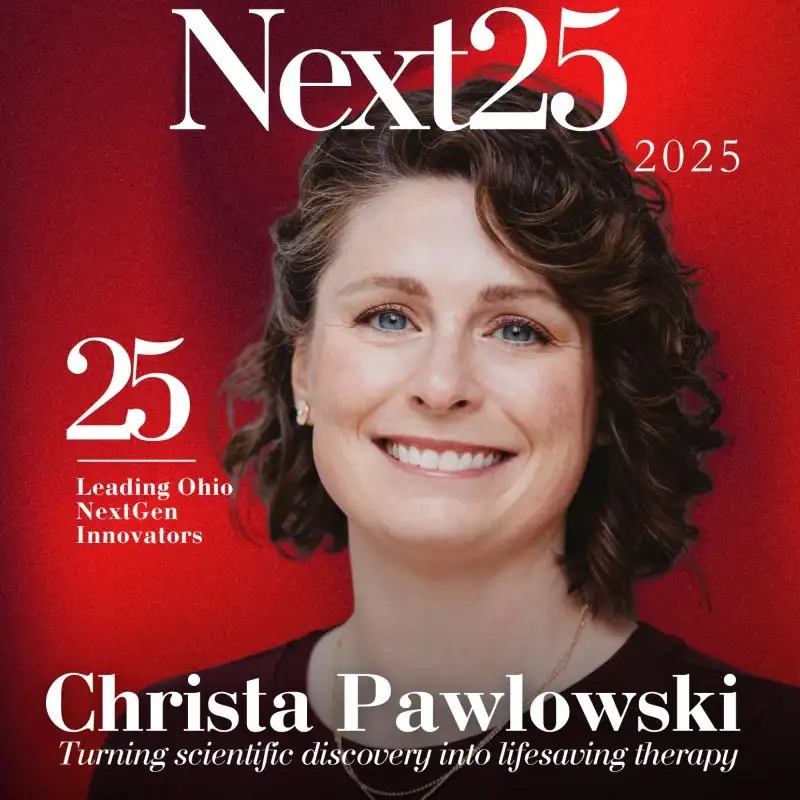
all right. Well, welcome everybody. This is Jim Haviland with weekly impact by Lay of the Land. And today I am very fortunate to have Dr. Krista Pulaski with me. She's a winner recently of the Next 25 award. And we're going to be talking about Ahama therapeutics and Elinar therapeutics. Dr. Krista, how you doing? Welcome to the show.
Christa Pawlowski (00:55)
Great, thanks for having me.
Jim Haviland (00:57)
Well, so I guess give us a, let's start with a brief overview. know, the, Michael Bruckman from Hema was on the, the larger Lay of the Land show. and they did a good long, long conversation there. I'll reference that in our podcast. but your, you've been behind the scenes with that one and also, Alan, so give me a little bit of your story, your story arc that got us to where are today.
Christa Pawlowski (01:09)
Right, right.
Sure. So I'm a transplant to Cleveland. I came up here for school at Case Western Reserve University starting as an undergrad, but continued all the way through my PhD at Case in the biomedical engineering department. So always really excited about how we can apply engineering principles and innovation to treat human health issues.
Jim Haviland (01:35)
Yeah.
Christa Pawlowski (01:48)
And so after finishing up my PhD there, I was really excited by the research that I was doing and Dr. Anirban's and Gupta's lab creating novel therapies for a variety of indications, one of them being a drug to stop bleeding. Got some really exciting data as a grad student and I couldn't live with the fact of abandoning that and moving on to something else. So I convinced him to start Haemotherapeutics with me.
to see if we can translate that into the clinic. I was, yeah.
Jim Haviland (02:20)
So you were radicalized by the outcomes. Okay. That's great.
Christa Pawlowski (02:26)
And in the meantime, as I was kind of getting Haima off the ground, I joined a local biotech accelerator called Biomotive, which was the for-profit arm of the Harrington project run by Beju Shah and basically was brought on to run operations on a few of their startup companies. So they would find interesting IP, new novel therapeutics from the universities, license that IP, form a startup company. And I ran operations on two of them.
One was a cancer vaccine company and the other was monoclonal antibody for cardiopulmonary diseases. So actually still working with that company called Al and Air Therapeutics to this day, trying to make a drug to treat pulmonary hypertension and COPD and other cardiopulmonary diseases.
Jim Haviland (03:07)
Mm-hmm.
You know, and I'm, uh, I like my work because I get to, uh, feed my curiosity. And, uh, I think talking about, you know, thinking about today's show, I learned a lot, um, about things I had known, you know, this is kind of like, you're working in a territory that is the sub genre of a sub genre to some extent, uh, that, uh, you know, and it's, it's interesting to me because you seem like an operator, but you've clearly been radicalized by, know, with this entrepreneurship gene. So, uh,
Christa Pawlowski (03:40)
Mm-hmm. Yeah.
Jim Haviland (03:46)
So tell me a little bit about that. I mean, the interesting part about Hema was that, you you started with Dr. Gupta, then you brought in a new CEO. Tell me about that journey a little bit. How'd you make that decision?
Christa Pawlowski (03:59)
Yeah, so when we first started the company, were...
really trying to get funding through non-dilutive sources. We have a drug that stops bleeding. Obviously there's a lot of interest from the military. And so as we were writing our proposals and trying to get in our first funding through non-dilutive sources, that's when I joined Biomotive. So when the first funding hit, I had to figure out what I was going to do with these two full-time positions. actually, yeah, only so much time. I knew Mike Bruckman, he was a postdoc.
Jim Haviland (04:25)
Yeah, there's only so much time.
Christa Pawlowski (04:32)
at Case Western in a neighboring lab, also doing nanoparticle research, and he was in the area with a blood glucose saliva.
I'm sorry, saliva glucose device startup. So he kind of was already getting into the startup space. And so we brought him on to kind of take the lead in the company while I was working with BioMotive. And he's done a good job at kind of getting the company off the ground and getting our funding in. And honestly, I'm much more an operator than a outward facing CEO type anyway. So it better suits my skillset.
Jim Haviland (05:03)
Okay.
Yeah, well, there's one thing that I noticed about you and I obviously know your husband and I had a sense of you, like you're really pulling some strings behind a bunch of really cool things going on. But that makes you comfortable. That's more comfortable than the alternative.
Christa Pawlowski (05:29)
Yeah, I mean, I'm a scientist by training. I'm deep in the weeds of the technology and the technical side of things. But I also just like to get stuff done. That's kind of my personality is if there's a problem I solve it, I get it done. And that's, you know, a lot of a lot of the times behind the scenes.
Jim Haviland (05:47)
Right. Well,
and I want to talk a little bit about your, you know, the business acumen, but, I think the Ohio X recognition. so I was happy to see it because, I think it's, you know, know, there's actually some good research on this being done now in the sociology space, around how Americans we do. We we've done this weird thing where we've made heroes out of these, the single genius behind things and.
Christa Pawlowski (05:52)
Mm-hmm.
Jim Haviland (06:14)
And I know that ideas are nearly worthless if you can't execute on them. So I was really happy to see you get recognized. But tell me about what you think about as far as next, being part of the next 25, class of 2025. What do you attribute that to?
Christa Pawlowski (06:31)
Yeah,
I mean, it was definitely an honor to be on that list. I think I was really happy that it brought highlight to not only my company at Hyma, but
Also the broader biotech ecosystem, you know, in, Ohio, we have amazing universities spinning out great innovations and we don't have, especially in the therapeutic space, we don't have those big pharma players in the area. So really the lifeblood of the biotech ecosystem is these small startups that are taking ideas, turning them into products, getting them to a point where they can, you know, hand it off to a transition partner or maybe take it all the way.
Jim Haviland (06:47)
Mm-hmm.
Christa Pawlowski (07:14)
along the lines. And so it was really nice to be able to highlight that in a broader setting.
Jim Haviland (07:21)
I appreciate that. I want to point out the, probably did not intend the, Calling it lifeblood. but that's a, it's pretty funny. see, you know, I think it's interesting too, cause I think it, we talk a lot about in the entrepreneurial space. know, Jeffrey talks about this in his show. And I talked about it mine where there's that notion of density of a talent density of, of expertise. and we do have it have the.
Christa Pawlowski (07:31)
Yeah.
Jim Haviland (07:50)
the knowledge base, but I've also pointed out many times that there is that the roadmap to commercialization is part of it. turning, you know, to have an ecosystem of businesses that can actually regenerate on regular basis, you need to have that exit as well. I mean, and that's the thing that we're maybe kind of missing is that guy who's going to buy us all. Right.
Christa Pawlowski (07:59)
Mm-hmm.
Mm-hmm. Yep.
Jim Haviland (08:19)
So when you think about people who are going to commercialize Hema, they're located, you know, Germany and Philadelphia. are they all?
Christa Pawlowski (08:30)
Yeah, mean, the big players and kind of our space are, you know, on the coasts and, you know, other countries.
Jim Haviland (08:37)
Okay. Yeah.
Christa Pawlowski (08:42)
I think this could be done a couple of ways. Like we could take it across the finish line. think there's a story to be told about growing the business in Ohio. We're great for manufacturing, like bringing the manufacturing of our product into the state. I think it's possible, but I think the economics of it is where the challenge is. There's not a huge...
funding base for life science technologies in the region. There's a few small players that help at the early stage, but I mean it takes hundreds of millions of dollars to get products like this to the market. So you have to rely on those partners that are elsewhere. But my goal would be to keep as much as we can take it from our Ohio, in our backyard, as far as we can. That's the goal.
Jim Haviland (09:13)
Got it.
Right.
Yeah, but I mean, it's almost impossible, right? Because I think there's, I mean, even when you get to an absolute, this guaranteed works reliably all the time, you're still a decade away from commercialization. Is that a fair statement?
Christa Pawlowski (09:36)
Yeah.
I mean, if we, once we get into kind of mid clinical development, phase two and phase three, you know, we're five years from the market. I think for a product specifically for Hyma, there's opportunities for commercialization a lot sooner than other therapeutics. Like we're going after a veterinary product right now. It's a totally synthetic.
Jim Haviland (09:55)
Okay.
Okay.
I love that.
Christa Pawlowski (10:11)
platelet analog,
so it works across species. So we're looking to develop it and commercialize it for companion animals. And that pathway is much shorter and we can start generating revenue in the next several years to kind of support the later stage clinical development. But also there's opportunities for because it is.
This is kind of a breakthrough technology. Like there's ways to get approval to use it in certain scenarios before getting full market approval with the FDA. So we're exploring like emergency use authorization in the event of a major conflict, military conflict or mass casualty event. there's ways to get it there. Yeah, as the world gets scarier. Yeah. And so there's ways to kind of be strategic about trying to get
Jim Haviland (10:43)
Got it. Sure.
Sure. We seem to have plenty of those around. Yeah.
Christa Pawlowski (11:05)
it on the market as quickly as possible to be able to generate revenue and kind of support the full development.
Jim Haviland (11:11)
Brilliant.
Well, I appreciate that. And I guess I have a sense too, unlike what you spoke, that there's a lot of support for the early stages of this, the middle ground is where we get stuck in biomed, right? So that's the long slog. But is there a point at this, right now, like if you had more funding, could you move faster towards those things? Is that really the, okay.
Christa Pawlowski (11:25)
Right.
Right.
Yeah, absolutely. think the COVID
vaccines are a great example of what, you know, almost unlimited funding can do on development timelines. I think, you know, a lot of things can be done in parallel instead of in series. you know, there's a critical path. You know, we have to demonstrate that it is safe in humans before moving into showing that it works. You know, like there's a clearly defined regulatory pathway that we have to follow and more resources just make it, you know, a little bit easier.
Jim Haviland (11:42)
You're right.
Christa Pawlowski (12:08)
to do that.
Jim Haviland (12:09)
Got it. And
in other places, how does that work? what would be the, I mean, I'm going a little bit outside what we typically ask about, but I'm curious, like if we were gonna, hey, if Krista had the magic wand for the moment and could actually make some resources happen here, it isn't just about money though. It's about people paying attention to what's going on and finding those resources. And what does that look like in other places, as far as you know?
Christa Pawlowski (12:25)
Mm-hmm.
Yeah, I mean, I think.
Like the ecosystem in Boston, for example, is really good for therapeutics companies. There's a lot of, I mean, we've been around for about eight years and it, we could have gotten faster, probably with more resources. you know, brought in funding kind of tranched here and there, I think in places like Boston, where there are investors who invest more in that early stage risky technology and they give, you know,
Jim Haviland (13:03)
Okay, all right.
Christa Pawlowski (13:05)
of funding and bigger chunks, it can accelerate that process. And then the strategic are, you know, being able to form a partnership with a big pharma company that then funds the R &D and kind of keeps their eye on the technology until it gets to a point where they either want to acquire it or, you know, take it on to lead the later stage development. think having the connection points with those strategic partners and investors is really an accelerator as well.
Jim Haviland (13:27)
Yeah.
You know, and I've made the point many times that it's it isn't like there isn't money in Cleveland. We just have to be able to prove that there's a way of making it back. And, you know, even when you when I've worked with some new funds, when they when they come up, it's like until that RR makes starts to show up, dude, I don't you're asking for a lot of faith. And I don't know that we have too many really great stories in Cleveland. But not that that's, you know,
Christa Pawlowski (13:44)
Yeah, yeah.
Yeah.
Yeah.
Yeah, there's not a lot to point to, yeah.
Jim Haviland (14:05)
that kind of intelligence doesn't really have a locus except we put it on there. So, So, tell me a little bit about what you kind of learned in this journey. I mean, you're getting a lot of things done, Krista. And my sense is you probably have some great advice for 2015, Krista, on where to focus and where not to focus. Do you have any advice for 10 years ago, Krista?
Christa Pawlowski (14:09)
I'm
Yeah.
Yeah, I think really the biggest surprise and I'm like a
scientist, you know, by heart and training and I am very analytical. I don't think I realized and more recently have just realized like how important team culture and kind of the soft skill side of the business really impacts the outputs. So, you know, building a team and making the culture is not something that just happens. It's something you have to actively cultivate. And when the team is, you know, is
Jim Haviland (14:52)
you
Right.
Christa Pawlowski (15:09)
They trust each other, they work, they rely, everyone's accountable. The team is so much more functional and gets stuff done so much quicker and is happier. And I learned along the way to put more energy and effort into cultivating that.
Jim Haviland (15:19)
Yeah.
You've mentioned a number of leadership buzzwords that I hammer into my clients on a regular basis. But actually how we put it and how I put it all the time is like, you have a culture automatically that comes, but do you have an intentional culture? Right? Do you have the culture that you really wanted? Rituals, artifacts, and language are what sociologists tell you go into a culture. And you get to choose those things when you're starting an organization. Like what are are rituals, artifacts, and language?
Christa Pawlowski (15:33)
Yeah
Right.
Jim Haviland (15:54)
And I love the way you said trust because it is the leading indicator of a successful organization is trust building. that's great. we'd like to ask the question about mentors and mistakes. Any big mistakes to call out? Any mentors you want to name?
Christa Pawlowski (16:13)
I think, you know, I've had several great mentors over the years. I think the biggest impact that I learned from my mentors and has kind of translated to me being a leader is whenever you show your team that you
that you respect their time and effort and energy. In a startup, we're going 100 miles an hour and there's always things to do. I think urgency is constant and burnout's real with everybody. But I think...
I've had mentors that have said, you we need to get this done over the weekend. I'm really sorry to interrupt on your time. Or if it's something they send out, like don't look at this until Monday, you know, just having that like respect for somebody's time really makes them respect you and want to do their best for you. And that's something I learned from a really great mentor that I had while working. Well, I still work with him at Allen Air Douglas Hay is the CEO and he was always very, you know, acknowledging that it's, hard and respectful of.
Jim Haviland (17:02)
Yeah.
Christa Pawlowski (17:21)
of the effort and energy I put out and it makes me want to do 10 times more for him.
Jim Haviland (17:27)
brilliant. Yeah,
I think that's exactly right. We use a couple of phrases we use for that. We want to turn our expectations into agreements. And one of our favorites is, Brene Brown, clarity is kind. And so being clear with people and then attaching it all back to the why. mean, we're building businesses and we have to get things done. like, hey, folks, I'm going to ask you to rally now because we have to get this done.
by this timeline for this reason. And I think this goes a long way because you're already bought in if you're working on a startup, you're already a true believer. But acknowledging that it is hard is really impactful. I appreciate that. Any individuals you want to call out as you walk across the dais and accept your award here? Thanks to the Academy.
Christa Pawlowski (18:05)
Yeah.
Oh, yeah, I mean, you guys.
Everyone, know, yeah, exactly.
mean, I think, you know, having an honor about Sengupta case has been a great advisor. I learned a ton from my team at Biomotive. Lizzie Barazowski was a great mentor to me there. Douglas Hay I mentioned. Tim Pelora, who I met at Biomotive and now is actually our executive chair at Haima. Just, you know, I've met a lot of good people along the way that have helped build me up personally.
Jim Haviland (18:47)
Brilliant.
Christa Pawlowski (18:52)
and my husband actually is the one who really forces me to do things like this interview or to get out there.
Jim Haviland (19:01)
Hahaha
For the record,
did yank his chain a little bit. I hey, what's Christophe to?
Christa Pawlowski (19:10)
Yeah, he's my biggest supporter, right?
Jim Haviland (19:13)
Well,
and I think, like I said, for me, it's important that people like you get recognition because it is the operationalizing of brilliance is, like I said, it's 90 % of the work, right? Having a great idea, it's going to sit in the lab forever unless someone picks it up and runs with it. so I appreciate you, Christa. I appreciate your time today and what you're working on. Yeah.
Christa Pawlowski (19:23)
Mm-hmm.
Yep.
Yeah. And one more thing I would be remiss
if I didn't mention my team, you know, I can come up here and tout all of our accomplishments, but like without the team who's actually running the experiments, you know, doing the data analysis, like the company is nothing. So I have an amazing team.
Jim Haviland (19:40)
yeah.
Well, and I trust you're doing a good job building that team and nurturing them along the way. And we'll look to see them also create new things as, as HAME would become successful. So, great, Krista, thanks so much for the time today. I really appreciate it. And, best of luck. I think you're doing great stuff.
Christa Pawlowski (20:03)
Yeah.
Thanks, I appreciate it, Jim. Bye.
Jim Haviland (20:12)
Thank you.
Creators and Guests