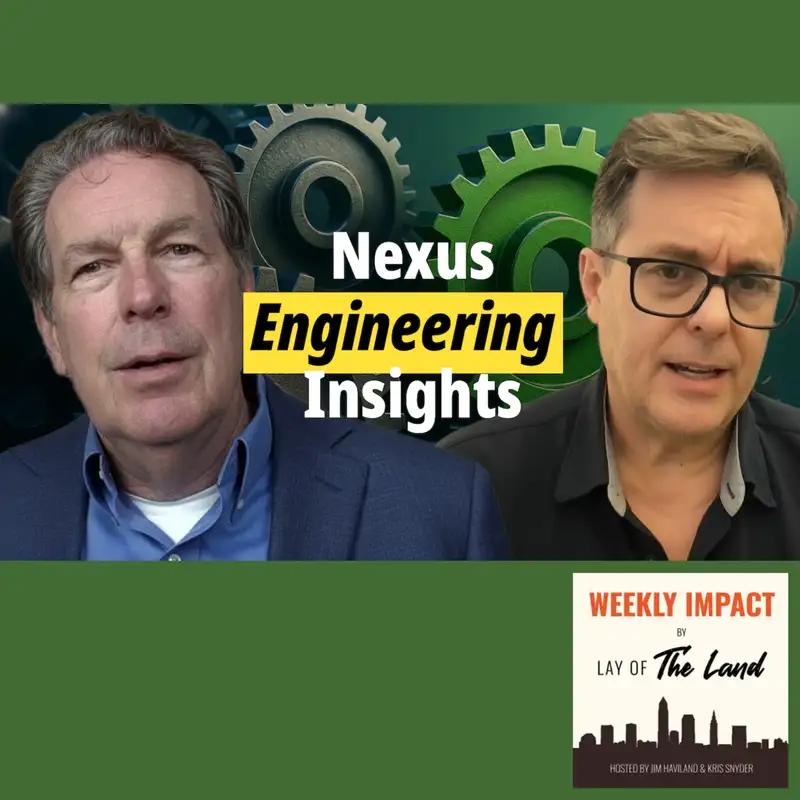
10-22-25 Jeff Herzog - Nexus Engineering Group
All right, welcome everybody.
This is Jim Havilland and you are listening to Weekly Impact by Lay of the Land.
This is our Smart 50 edition, know, as the launch of our new season.
And we are just talking to all of the Smart 50 honorees to find out what makes them so
smart.
Today I'm talking with Jeff Herzog from Nexus Engineering Group.
Jeff, I'm gonna assume because you're in engineering group, you're a pretty smart guy, but
maybe start by giving me a little bit of your story arc as you got to this moment.
what brought you to today from a career perspective.
Okay, yeah, well, trying to figure out if I'm smart or not.
That's kind of you can decide that.
I guess it's in the eye of the beholder.
Sometimes I don't feel very smart, that's for sure.
Sometimes, hey, you get an idea, it's like, wow, that was pretty good.
Do know where that come from?
So how did I get where I'm at?
Like you said, I'm an engineer.
I grew up.
with my mom and dad.
My dad was an engineer, so that's where I started to learn about engineering.
But what I did learn mostly from my dad was how much he loved being an engineer.
He just loved it.
And he told me so many times that the most important thing in life is to find a job or do
something that you really like and you're really passionate about.
So I took that to heart, and I still feel that way.
All through my career I've done things that I really enjoyed and done some really cool
things in my opinion.
So I started out with my education at Case Western as a mechanical engineer and then went
on to get my MBA after I had started working at the Standard Oil Company.
And that was my first job out of school.
The company was called SOHIO at the time.
Actually founded by John Rockefeller.
I joke around that he was still there when I joined, but he really wasn't.
He may have felt like he was around.
Yeah, you could kind of feel his spirit around there, but it was right after the Standard
Oil had completed the Alaska pipeline, which was a major, major engineering and project
feat.
And a lot of the people that I grew up with in Lima, Ohio, believe it or not, where there
was a big Standard Oil facility, worked on that project in Alaska.
There weren't that many people in Soho, but people from Lima Ohio went up to work on that.
And that was also another inspiration.
But anyway, so started at Standard Oil, did project work, learned about how to lead people
from experiences by leading projects where I really didn't have any authority over the
people on my team.
So it was really around learning how to influence people to
kind of achieve a common objective, a common vision of what we were trying to do with the
project.
So that was my, kind of my first exposure to really leading and managing people.
As time went on, Standard Oil was bought out by British Petroleum or BP.
Got to meet people from all over the world through our colleagues at BP.
I worked for a gentleman from London who had come over to
Cleveland, Ohio and I learned a lot from him and I'll just a whole different perspective
on the world from that kind of British perspective and And really a big international oil
company standard oil was a big regional company and turned into a major oil company But we
really didn't have kind of the international perspective that people from VP Had so I
learned a lot from that and then went on
to work in a consultancy here in Cleveland where I learned really about
consulting world, but also building a business.
I came in and helped them build part of their company that was delivering services to the
oil and chemical markets and really learned what it takes to grow a business from that
experience.
So started with a small team and ended up when I left there, we had a couple hundred
people working in that group.
So all the things that
takes to put a lot of people together to focus in on a business I learned from that.
You know, it's when we coach people through those early stages, it's pretty much, if you
get to a couple hundred people, you've gone through four or five different types of
management styles you've got to go through, right?
mean, it changes over time as you grow.
And so, interestingly, if you can grow a business from zero to 200, you know a lot about
managing through a lot, especially that you don't really know anything yet, that you've
got every situation that we knew.
Yeah, so this was in a company that was already established, but it wasn't a very large
company.
that 200 people that we really added to that team was a big, that was almost, you know,
almost 100 % growth for the company.
That was what we started with.
But you're right.
You you learn, it wasn't just going out and selling, but it was about the systems and the
people and managing and getting the right people.
And also kind of the management of change, you know, as far as what it takes to evolve a
company.
A lot of people like being in a small company and they kind of like the way it is and
they're not really into making it bigger.
You know, they just leave me alone.
I like it the way it is.
So, so learned about that.
You need those people early on, but eventually they just don't make the transition, right?
That's just the way it is.
Yeah, unfortunately some don't and it's not because they're bad people.
just don't want to be part of a bigger operation.
it.
They they don't go under fit.
We're going someplace.
You know, do you want to join us?
No, I'm not really into that.
That's fine.
they, yeah, so yeah, so learned a lot about that and, you know, learned a lot of, you
know, hard lessons, things that was like, wow, I don't want to do that again, because it
really didn't work out very well, or there was a lot of probably unnecessary stress you
put on the team.
And when people get stressed out, they're not worrying so much about taking care of the
customer as they are about.
Yeah.
you know, as they should be.
So, really learned a lot from
And also along the way from the experience both at Standard Oil BP and then at the
consultancy, I was working with my future business partner, Marianne Corrao.
The two of us, she's younger than me and was a co-op at SOHIO when I was there.
So I was a few years older than her, but the two of us got to know each other and we just
worked really well together.
So we went through these similar experiences.
together and I think she learned probably more than I did.
She's chemical engineer so they tend to learn more than a mechanical engineer.
You know how that goes, right?
But she, yeah, you know, the hierarchy.
So anyway, so the two of us shared that experience together and again, that was really
valuable for when we decided to start Nexus Engineering Group.
several years after leaving the consultancy.
So we left there, both of us.
I left and then I recruited Marianne to leave as well and come over to a gas company and
we were doing work down in Houston with the oil and the chemical industry down in Houston.
A big expansion in the supply of hydrogen to refineries and chemical plants.
It was an exciting time to be in Houston and I think it's always an exciting time to be in
Houston.
tell you the truth.
But yeah, we we helped grow that business to expand this hydrogen operation and learned a
lot about, you know, contracting and legal issues that you need to think about when you're
putting contracts together, risk issues and business issues.
So we really helped that company expand their business and then we started Nexus.
That's interesting.
You tell your story, I get the sense that in our consultancy, we talk about going through
these inevitable stages of growth and you're basically slowly building and intentionally
building your infrastructure to be that larger, more successful company.
But you kind of learned all those stages through this other employment before you even
started Nexus.
So you were set up for success, it sounds like.
Yeah, we like to think so, but you know, so when we started the company, you know, it was
a partnership and we met with a lawyer here in Cleveland to help us put the company
together.
And, know, one of the first things he said was like, Hey, I'll do this for you.
I'll charge you money to do it.
But partnerships never work.
I figured this, you guys are going to be, you'll be done in a couple of years.
It's just my experience.
Right.
So don't get too excited about this big dream you two have over there.
So I'm like, really?
You think it's gonna work?
not going to double down on his bets then because it's been 25 years now.
guys been doing, how long you been doing this?
20 years.
Yeah.
Yeah, so the two of us started and now we have like 250 employees in four different
offices.
It's been...
I mean, you've been relatively consistent with your growth.
Yeah, yeah, we've grown every year that we've been in business.
Some years had more growth than others.
And it's not just about growing, but, you know, it also helps stabilize the firm and, you
know, create opportunities for people in the firm and then, you know, be more profitable.
You know, can spread out your overhead, you can, you can afford to do some things as you
get bigger.
So,
It's been a good thing, not just growing, but making the business more sustainable,
robust, whatever words you want to use around that.
course.
Well, let's go into what your lawyer told you, because I think it's true.
A lot of partnerships don't work.
And quite often, it's because we don't learn the lessons of communication.
We don't learn to be humble.
What do you think the keys were for it working out for you?
Well, number one, you have to have the right partner.
you have to be aligned.
Yeah.
And you really have to be aligned on what you're trying to do with your business.
Early on, if all you want to do is one partner wants to do something completely different
than the other partner, well, you're in trouble.
You're in trouble right away.
We say that all the time alignment is the key without alignment you're lost.
important and also by having the right partner where you can actually build off of each
other it's almost like a marriage it's kind of like a good marriage right where the two of
you know the two partners make each other better and they offset each other's strengths
and weaknesses and I think Mary Ann and I had that combination where you know we're both
engineers but our
you know, our strengths and weaknesses are different enough that they offset and
complemented each other.
And then, you know, we have a lot of similar strengths as well.
having the right partner, having a common vision, being aligned on what you're trying to
do with the business is really how it works.
And I'd say there's been quite a few, you know, really successful partnerships.
Hewlett and Packard, Shortland and Williams, you know.
Actually, John Rockefeller had some partners when he started that helped turn Standard Oil
into just a brilliant company, you know, when you read the history about what they did.
You know, so it can be done.
I didn't realize there was that many failures in the partnership world.
Well, think it's, but you, it sounds like you were very, you were very conscious about it.
You were self-aware of your strengths and weaknesses when you started this.
And that, that is really the key, I think that's, that's the unlock is like to, realize
that there's, I've got weaknesses.
You know, I think when I see it fail is because some founders don't realize they're not,
not self-aware enough to know where their weaknesses are and that they need to be covered
by somebody.
So.
have just been a little bit of maturity too.
Like, you know, I was well into my forties when we started.
Mary, I was, you know, a few years younger, but it wasn't like we were 20 year olds in a
dorm room trying to start up a, you know, a company where you just really hadn't been beat
around by life enough yet.
so I, I think a little bit of experience, no.
really good for that.
Yeah.
getting your butt kicked is really good.
Yeah, I'm kidding.
do you think makes Nexus engineering smart or unique?
I I know I like the model from the standpoint is it's not the glitzy front end, but you
just have to, I mean, my guess is you have to be able to execute in an excellent way every
time.
It fits very much with the engineering ethos of like, you're just executing really well
every time and you need people that are going to execute well.
Right, so I totally agree with what you just said.
I think what makes us unique, and it's part of where our name Nexus, Nexus means
connection, right?
And when we thought about, Marianna and I thought about what we thought the world needed,
because we had been on the consultancy side and been on the owner, what we call the owner
side, the people that are actually making the investment.
And one thing we saw from the owner's side is a lot of consultants would come in, really
smart engineers, can calculate anything like incredibly difficult analysis and
calculations and design work.
But they really had no understanding and very little interest in why you were doing the
project.
What was the business driver behind?
project.
And so the whole idea of Nexus is that we felt that we had the business savvy and the
technical chops to connect those two things together.
What you're trying to do with the business versus and connect it to the technical skill,
the project delivery skill that would take to really make a good investment.
You people go to an engineering, procurement and construction firm.
because they're making an investment and they're usually investing, when they come to us,
they're investing a lot of money.
And they want to return, they have shareholders they have to satisfy and they really want
that investment in a project to be successful and to pay out.
So that was what we felt was unique about our approach is that we wanted to bring that
understanding of the business along with the technical project chops to the table.
And we thought that was missing in the market.
And I think it still is missing.
well, but I think it's, it was really interesting about that is when we coach clients
into, you know, how to build a bigger and bigger business, you have to have a strong why
so that people below you can make good decisions.
Right?
So that's part of why you're cascading that focus as to why you're doing what you're doing
so that other people can align with that, right?
Back to your alignment and make equally good decisions.
because everyone's going have to make decisions every day otherwise you become the choke
point for the organizational role.
So it's interesting how you're just duplicating that into a very large degree.
How large are the projects that you're working on?
there like hundreds of millions, right?
Well, some of them are, you know, it's pretty rare when we do a project over $100 million.
But we will do, and it's again, that's kind of our business philosophy.
We chase clients, not projects.
So we want clients that really need our kind of skill.
they...
Typically, our clients will bring a portfolio of projects to us where they may have, like
our biggest client, we may do 100 projects a year for them.
So a lot of those projects are smaller, less than a million dollar capital investments and
where the engineering fee on that may be $100,000 or less.
But then there'll be a few of the larger projects.
So we're set up to do a lot of small projects and then the occasional larger projects.
We have systems that can handle both.
on any given month, you know, we were putting out 400 invoices.
You know, there's an invoice for every project.
So we're working on several hundred projects all the time.
And there are different phases.
And so there's...
you know, a lot of activity every day.
I like to say the phone rings, although the phones don't ring, you know.
But, you know, somebody calls up and they have another challenge.
They have another investment they're trying to make.
And, you know, and so we get on that.
And at the same time, we're finishing up jobs we may have been working on for several
months, maybe sometimes several years.
So it's constantly changing.
demand from the customer and our project workload and things like that.
our ability to adapt to that is pretty incredible.
And it's, I don't think you can even write it down.
It's just kind of how we do things, you know?
It's pretty amazing.
mean, you know, right, culture is what happens when no one's watching, right?
So you build a culture of execution against that, clearly.
So tell me, we've already talked about a couple of things.
We talked about alignment.
We talked about having a clear why, but what, do you have any other leadership nuggets
that have been part of, you think, your success so far?
Well, I think my own personal leadership success and just thinking about, you know, in
preparation for this conversation and, you know, you do learn from experience, right?
Good and bad.
One of my first experiences in college was joining a fraternity and becoming, and I became
an officer in a fraternity and eventually the president of this chapter at Case Western.
And I learned so much from that, know, conflict resolution, budgeting, running an
effective meeting.
know, college, you know, students don't have a lot of time for anything, let alone some
meeting that's like drifting all over the place.
So I learned a lot from that experience early on.
And the other thing about being a fraternity, you know, your fraternity brothers are
brutal.
If they don't like something, they'll tell you.
They're not going to sugarcoat it.
Right.
So anyway, long answer to that.
So I would say that was my first thing.
And then just various journeys along the way where I learned by making a lot of, I would
say, really valuable mistakes, know, things that I thought were a good idea at the time,
really dumb looking back on them.
how I treated people, mistakes I made, not thinking through, all kinds of experiences that
build into kind of shaping and being humble enough to realize, you know what, that was
really not good.
I could do, I own it.
that's really one of the themes that's come from these conversations is the role of
humility.
The other thing I wanted to just put a point on is that when you talk about leading a team
that you weren't really in charge of, it reminds me of one of my favorite quotes on
leadership.
Jim Collins actually quoted it from Colin Powell, who adapted it from Eisenhower, a couple
of guys that know about leadership.
And he says,
Leadership is the art and science of getting people to want to do what needs to be done.
ah Right, so it isn't about having control, but it's influence.
It's the ability and desire to influence.
Yeah, and if you can't explain, I mean, that's part of what we try to do at Nexus.
Like, why is somebody making, why are they doing this project?
What are they trying to achieve?
And right, and a lot of times the clients that bring the projects to us are not real sure
about that.
So we kind of push them to, hey, wait a minute.
what is it that's really important about this job?
Because they may have 20 jobs on their desk.
I got to think about that a little bit.
I got to find out a little bit more because if we don't understand that, we can be going
down road A when we should be on road C.
And we're doing great work for some project that really shouldn't be executed.
Great work in the wrong direction is not great work.
Yeah.
Well, Jeff, you talked a little bit about mentor, one of your mentors from BP.
Any other mentors you want to shout out on this journey?
Yeah, I've got, you know, thinking back on it, yeah, my Soho colleagues, my BP colleagues,
Mary Ann Correia, of course, the people I worked for at the consultancy after I left BP, I
learned a lot from them, both good and bad.
You know, they were struggling.
They were learning along with everybody else.
I saw them do some things really amazingly well and some things that like, whoa, that was
not good.
guy named Tony Rach that was there with Maryann and me when we started the firm.
He's 85 years old now, but one of the best sources of wisdom I've ever been around, you
know, about dealing with people and he's an engineer and he's sharp as a tack.
you know, I just learned a lot from him.
One of my friends and now a colleague here at Nexus, Neal Curran, totally different
background, brilliant engineer.
but one of the most clever people I've ever been around.
can figure just about anything out.
Some of my colleagues from other consultancies along the way, guy named Tony Smith and
Brendan Shanley.
Brendan actually works for us now and heads up our whole project delivery team.
But those two were brilliant experts around project controls and the whole
are in the science of project controls and risk management and taking data and figuring
out where things are going ahead of time before you're, you know, hopefully keep you on
track and keep you out of trouble.
Oh my gosh.
Right.
And then, then along the way, my daughter, Emily, Emily Gambill came over and joined the
firm and
I've learned a lot from her, know, obviously a younger person, a woman, not an engineer,
marketing background, got her MBA at Northwestern, but just a different perspective, you
know, when you talk to people that are, you know, in their 30s and 40s, you know, they
just look at things differently and it kind of reminds you of kind of how you looked at
things too when you were, you know, starting to raise a family and work.
But there's just a different perspective from people of that age.
then last but not least, my wife.
I've been married to the same woman forever.
And I've learned a lot from her.
She always delicately points out my flaws, but not really all that delicately sometimes.
She's just a great person, but...
She'll look at me and go, what are you doing?
My cat is such a bad approach.
I'm like, OK, I hate to admit it sometimes.
She's usually right.
So she's just got a great perspective on interactions with people and things like that.
So there's been a lot of people that I've learned from.
One thing I did learn from a guy named Randy Fletcher, who is an old VP colleague and
we've worked together for years.
One thing I always think about with him is he says, your team, when you're leading a team,
they'll pick up on about half of your positivity and 100 % of your negativity.
Now don't know where he got that data, but it's like, hey, you want, kind of back to
getting people to
kind of a line on an objective, but if you're complaining about it or, you know, this is
stupid, but we're gonna do it, know, your team's not gonna follow you into like a really
stupid thing, you know.
They wanna feel good that, you know, we are on a mission, that it's gonna be a good
outcome, and there's a good reason, you know, and a positive reason why we're doing
things.
I've learned a lot from Randy over the years just around leadership and he just has such a
great perspective on that.
So I've learned from all those people.
Jeff, I appreciate that, and I found this a lot with great leaders is that when I asked
them about their mentors, they have a list.
It's being metacognitive about the fact that I have learned a lot along the way.
So we'll leave it there.
Jeff, are you going to be at the event on the November 7th?
Yes.
All right, well maybe we'll see you there.
Jeff, thanks so much for the talk today.
I really appreciate it.
Thank you.
uh
Creators and Guests